By Dr. Bharat Vaidya B.A.M.S., M.D.
Owner and Founder of Ayurved Sadhana
Dean and Senior Faculty at Ayurved Sadhana
The Forgotten Legacy of India’s Earliest Modern Surgical Historiography
Beginning
Among the pioneers who defended the scientific heritage of Ayurveda during the colonial era, Vaidyaraj Prabhuram Jivanram (1832–1902) stands as a monumental figure. A scholar of Vedanta, practicing Ayurvedic Vaidya, and realized yogi, he worked to rescue Indian medical knowledge from distortion at a time when European narratives often dismissed India’s surgical achievements.
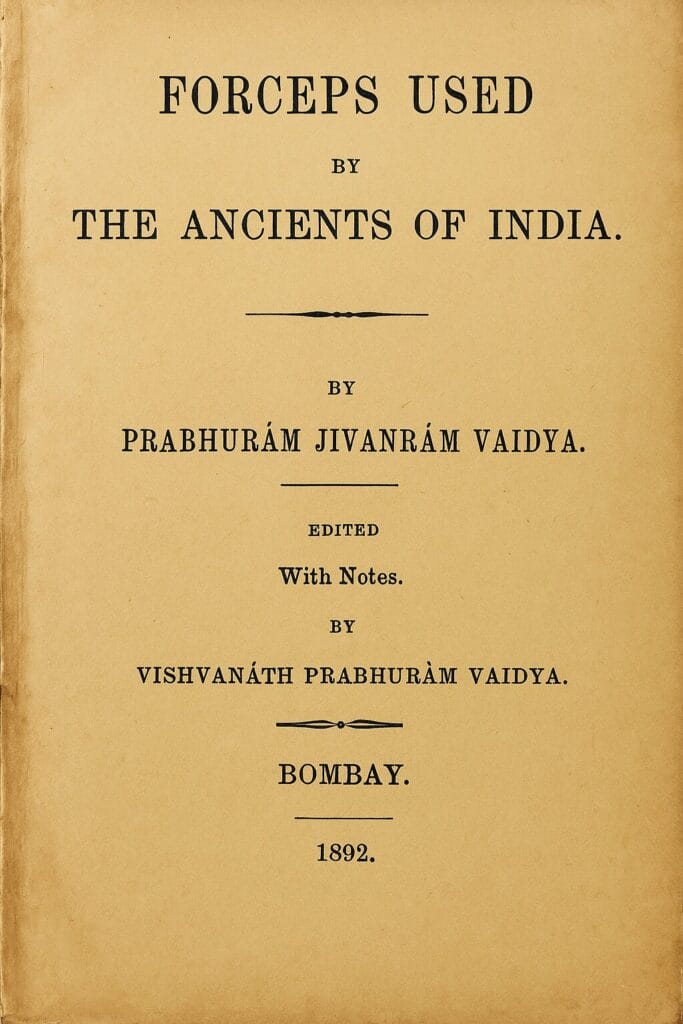
One of his most remarkable contributions is the rare monograph “Forceps Used by the Ancients of India” (Bombay, 1892), edited with notes by his erudite son Vishwanath Prabhuram Vaidya. Printed in English, Sanskrit, and Gujarati, it is among the earliest scholarly attempts to document, analyze, and defend India’s ancient obstetric and surgical instruments as described in the Sushruta Samhita and related traditions. Today, copies survive only in a handful of repositories, including holdings in London—making it a treasure of Ayurvedic and world medical history.
A Scholar, Sage, and Defender of Ayurveda
Prabhuram Jivanram was not merely an author; he was a Vedantic master, the Patta Shishya (chief disciple) of the Shankaracharya of Dwarka Peeth, and a yogi who entered Maha Samadhi in Bombay in 1902. He authored numerous works on Ayurveda, Sanskrit, Vedanta, and Sannyasa Dharma, many of which informed the curriculum of Aryan Medical School (Prabhuram Ayurvedic College)—an early institutional center of Ayurveda in western India.
Revealing India’s Surgical Heritage: The 1892 Treatise
In this extraordinary monograph, Vaidya Prabhuram challenges the assumption that obstetric instruments were purely European inventions of the early modern period. He compares Sushruta’s Sandamsa (extractive tongs) and Anigraha, along with related techniques of rotation, traction, and controlled extraction, with their European counterparts—arguing that classical Indian obstetrics documented sophisticated tools and methods long before they were widely recognized in Europe.
He writes with clarity and conviction:
“The application of forceps in case of difficult labor, the different turning, flexing and gliding movements and other obstetric operations… were first systematically described by Sushruta long before fillets and forceps were dreamt of in Europe, and thousands of years before Christ.”
— Prabhuram Jivanram Vaidya, Forceps Used by the Ancients of India (1892)
Technical Insight: Sandamsa and Anigraha
After analyzing Sanskrit passages, drawings of ancient yantras, and European claims, Prabhuram concludes:
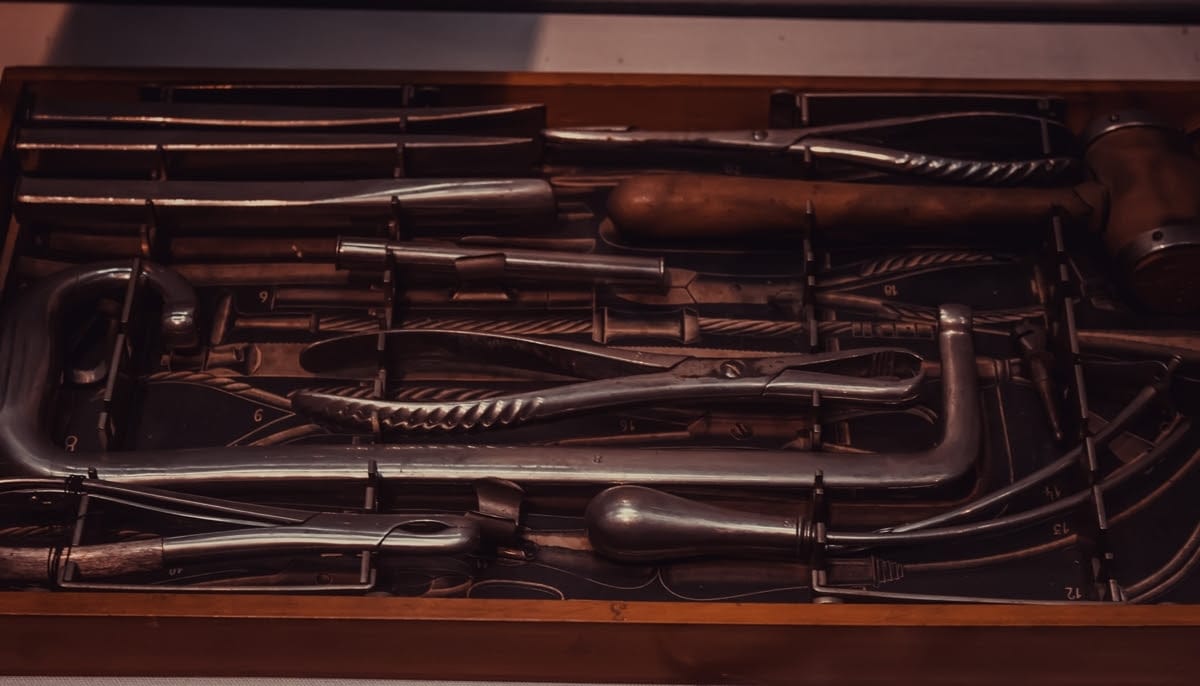
“The Sandamsa Yantras are pairs of tongs neither curved nor rough. The instrument was supplied with a ring which, when it moved a little forward, kept the ends close together. The Anigraha is a pair of tongs without such a ring.” (1892)
The ring mechanism resembles the lock of modern forceps; the straight design parallels early cephalotribes; the grip-and-release function reflects advanced biomechanical understanding. This was among the first Indian works to compare Vedic yantras to contemporary surgical engineering with scientific rigor—decades before broader scholarly restoration efforts of Ayurveda’s history.
The Father–Son Collaboration
The 1892 edition’s editorial notes by Vishwanath Prabhuram Vaidya provide philological clarity, surgical interpretation, and historical cross-references—making the book not merely a translation but an early masterclass in medical historiography. The family’s scholarly lineage would continue through Dr. Popat Prabhuram Vaidya, Dr. Pratapkumar Popatbhai Vaidya, and Dr. Prafulla Pratapkumar Vaidya.
In the End
Forceps Used by the Ancients of India stands as a foundational document in the global history of surgical instruments. Long before modern obstetrics matured in Europe, Sushruta and classical Indian surgeons described forceps-like yantras with deep anatomical understanding. Vaidya Prabhuram Jivanram’s monograph boldly reclaimed this legacy and helped re-situate India within medical history. In an era when OB-GYN leans heavily on instruments, his work reminds us that scientific obstetrics has deep roots in the Ayurvedic tradition.
Acknowledgments / Mentions
-
Sushruta Samhita (India)
-
Early institutional history: Aryan Medical School / Prabhuram Ayurvedic College
-
London rare-book repositories (noted holdings)
-
Later historians and revivalists: Bhav Mishra, Chakrapani Datta, Madhava, and others
P.S. My thanks to the museum curator and library staff in London who facilitated viewing of this rare family volume and related archival materials.
All rights reserved — Ayurved Sadhana Vidyalaya, Colorado, U.S.A.
Please connect with us if you have any questions about this blog at info@ayurvedsadhana.com